

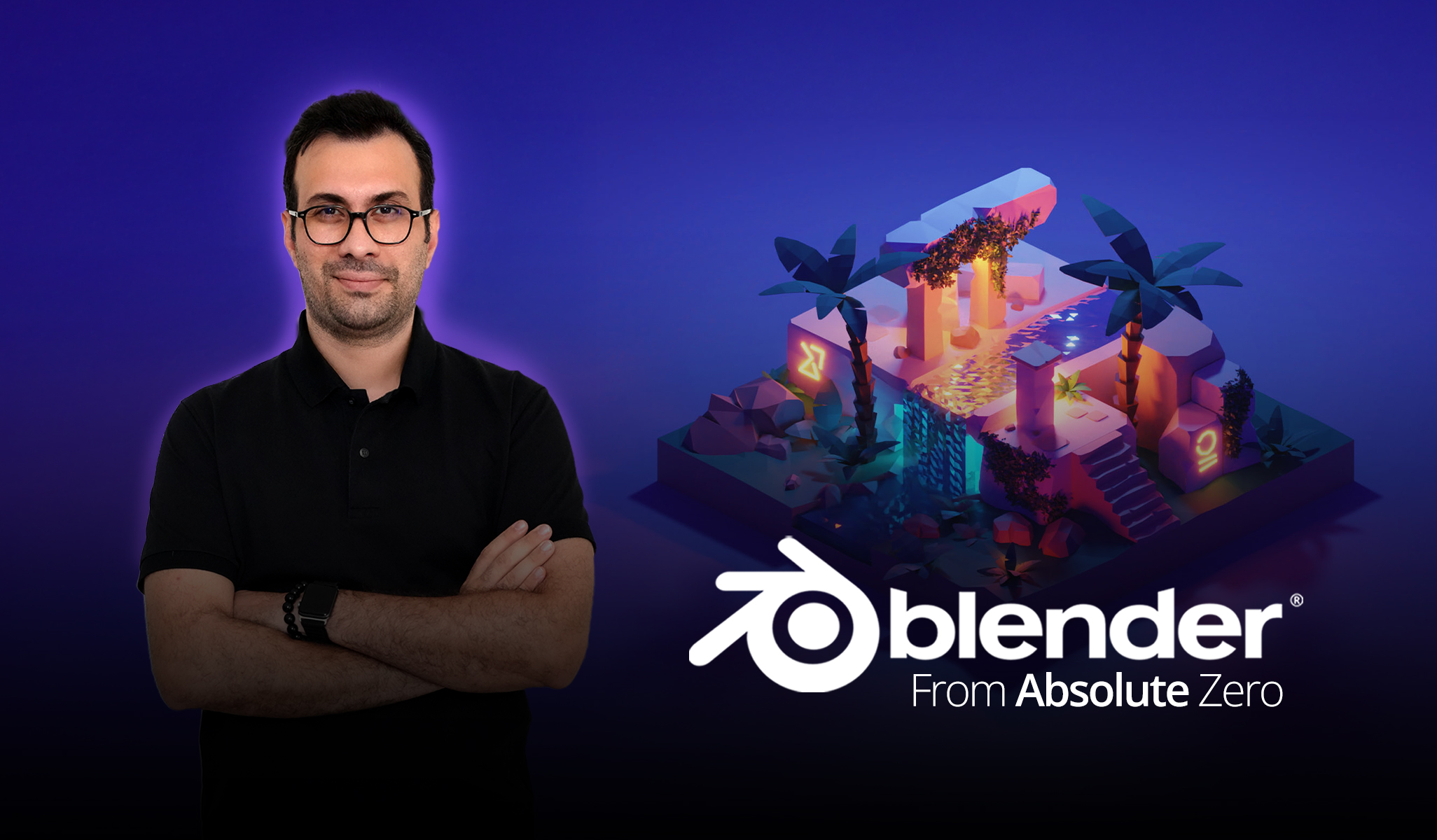
Blender From Absolute Zero
This course is designed for absolute beginners who have never used Blender before. By the end of this course, you will confidently navigate Blender, model basic to intermediate objects, apply materials, light scenes, render images, and understand the foundations of 3D thinking.
No prior 3D, design, or technical experience is required.

Instructor
About This Course
Blender From Absolute Zero
A Complete Text-Based Course for Beginners
This course is designed for absolute beginners who have never used Blender before. By the end of this course, you will confidently navigate Blender, model basic to intermediate objects, apply materials, light scenes, render images, and understand the foundations of 3D thinking.
No prior 3D, design, or technical experience is required.
Course Outcomes
By completing this course, you will be able to:
Understand what 3D graphics are and how Blender fits into the industry
Navigate the Blender interface confidently
Model simple and structured 3D objects
Apply materials and textures
Set up lights and cameras
Render high-quality still images
Develop a solid foundation for advanced 3D paths (animation, game assets, VR, product design)
Chapter 1: Introduction to 3D and Blender
1.1 What Is 3D?
3D (three-dimensional) graphics represent objects with width, height, and depth. Unlike 2D images, 3D objects exist in a virtual space and can be viewed from any angle.
3D is widely used in:
Films and animation
Games
Architecture and interior design
Product visualization
Virtual Reality (VR) and Augmented Reality (AR)
1.2 What Is Blender?
Blender is a free, open-source 3D creation software. It includes tools for:
3D modeling
Sculpting
Texturing
Lighting
Rendering
Animation
Simulation
Blender is used by freelancers, studios, and companies worldwide.
1.3 Installing Blender
Visit blender.org
Download the latest stable version
Install using default settings
Chapter 2: Understanding the Blender Interface
2.1 The First Launch
When you open Blender, you will see:
A splash screen
A default scene (cube, camera, light)
This default scene is your starting point.
2.2 Main Interface Areas
3D Viewport: Where you see and interact with objects
Outliner: Shows all objects in the scene
Properties Panel: Object, material, render, and scene settings
Timeline: Used mainly for animation
2.3 Viewport Navigation
Rotate view: Middle Mouse Button
Pan view: Shift + Middle Mouse Button
Zoom: Scroll Wheel
Learning navigation is essential. Practice until it feels natural.
Chapter 3: Basic Object Management
3.1 Objects in Blender
An object is anything placed in the scene: mesh, camera, or light.
3.2 Selecting Objects
Left-click to select
Shift + click to select multiple
A selected object appears highlighted
3.3 Transforming Objects
Move: G (Grab)
Rotate: R
Scale: S
You can constrain movement using axes:
X, Y, or Z after pressing G, R, or S
Chapter 4: Edit Mode and Mesh Basics
4.1 Object Mode vs Edit Mode
Object Mode: Move or transform entire objects
Edit Mode: Edit the geometry of an object
Press Tab to switch modes.
4.2 Mesh Components
Every mesh is made of:
Vertices (points)
Edges (lines)
Faces (surfaces)
You can switch between them using:
1: Vertex mode
2: Edge mode
3: Face mode
4.3 Basic Editing Tools
Extrude: E
Loop Cut: Ctrl + R
Delete: X
These tools form the foundation of modeling.
Chapter 5: Modeling Your First Object
5.1 Understanding Modeling
Modeling is the process of shaping geometry to create an object.
5.2 Simple Modeling Exercise (Table)
You will:
Scale a cube for the tabletop
Extrude legs downward
Adjust proportions
This teaches:
Scale
Extrude
Proportion control
Take your time. Accuracy comes with practice.
Chapter 6: Modifiers – Non-Destructive Modeling
6.1 What Are Modifiers?
Modifiers change an object without permanently altering its geometry.
6.2 Common Modifiers
Subdivision Surface: Smooths objects
Mirror: Symmetrical modeling
Array: Repetition
Modifiers are essential for clean workflows.
Chapter 7: Materials and Colors
7.1 What Is a Material?
A material defines how an object looks: color, roughness, and reflectivity.
7.2 Applying a Material
Select object
Go to Material Properties
Click New
Adjust Base Color
7.3 Understanding Shading
Rough surfaces scatter light
Smooth surfaces reflect light
Chapter 8: Lighting Basics
8.1 Why Lighting Matters
Lighting defines mood, depth, and realism.
8.2 Types of Lights
Point Light
Sun Light
Area Light
Spot Light
8.3 Basic Lighting Setup
One main light (key light)
One softer fill light
Chapter 9: Camera and Composition
9.1 Camera Basics
The camera defines what will be rendered.
Add camera: Shift + A → Camera
View through camera: Numpad 0
9.2 Framing Your Scene
Adjust camera position
Use rule of thirds
Avoid cutting objects awkwardly
Chapter 10: Rendering Your First Image
10.1 What Is Rendering?
Rendering converts your 3D scene into a final 2D image.
10.2 Render Engines
Eevee: Fast, real-time
Cycles: Realistic, physically-based
10.3 Rendering Steps
Choose render engine
Set resolution
Press F12 to render
Chapter 11: File Management and Saving
11.1 Saving Projects
Save often: Ctrl + S
Use clear folder structures
11.2 Exporting Images
File → Save As (Render window)
Use PNG or JPEG
Chapter 12: Next Steps After This Course
After completing this course, you are ready to:
Learn advanced modeling
Explore animation
Create game assets
Build VR-ready models
3D is a skill built through consistency, not speed.
FAQ
Check the frequently asked questions about this course.

Curriculum Overview
This course includes 1 modules, 1 lessons, and 0:20 hours of materials.
Course Outcomes
By completing this course, you will be able to:
Understand what 3D graphics are and how Blender fits into the industry
Navigate the Blender interface confidently
Model simple and structured 3D objects
Apply materials and textures
Set up lights and cameras
Render high-quality still images
Develop a solid foundation for advanced 3D paths (animation, game assets, VR, product design)
Course Specifications





Shima